When it comes to strengthening inclusive education, there is one group of stakeholders whose insight, motivation and lived knowledge must not be underestimated: parents and caregivers.
They see the child who returns home silent. They witness the small daily indignities and reluctance to attend class. And crucially, they carry a motivation that no professional obligation can match: unconditional love and fierce determination for their child to thrive.
That is why parent- and caregiver-led associations are a vital addition to the education system. And the Association of Caregivers for Children with Disabilities in northwest Syria is a powerful, compelling example of how family members can become a force for improving inclusion and equity in schools.
Supporting advocacy with parents and caregivers
The Association first began to take shape as part of a Manahel-supported intervention to open special education rooms in schools and provide specific support to learners with disabilities. Parents and caregivers were invited to attend workshops to understand the initiative and to build skills for supporting their children to attend school.
As parents developed confidence and knowledge, they began identifying the inclusion barriers their children faced and advocating for those barriers to be removed. In 2022, the Association was formally established with a group of 40 parents.
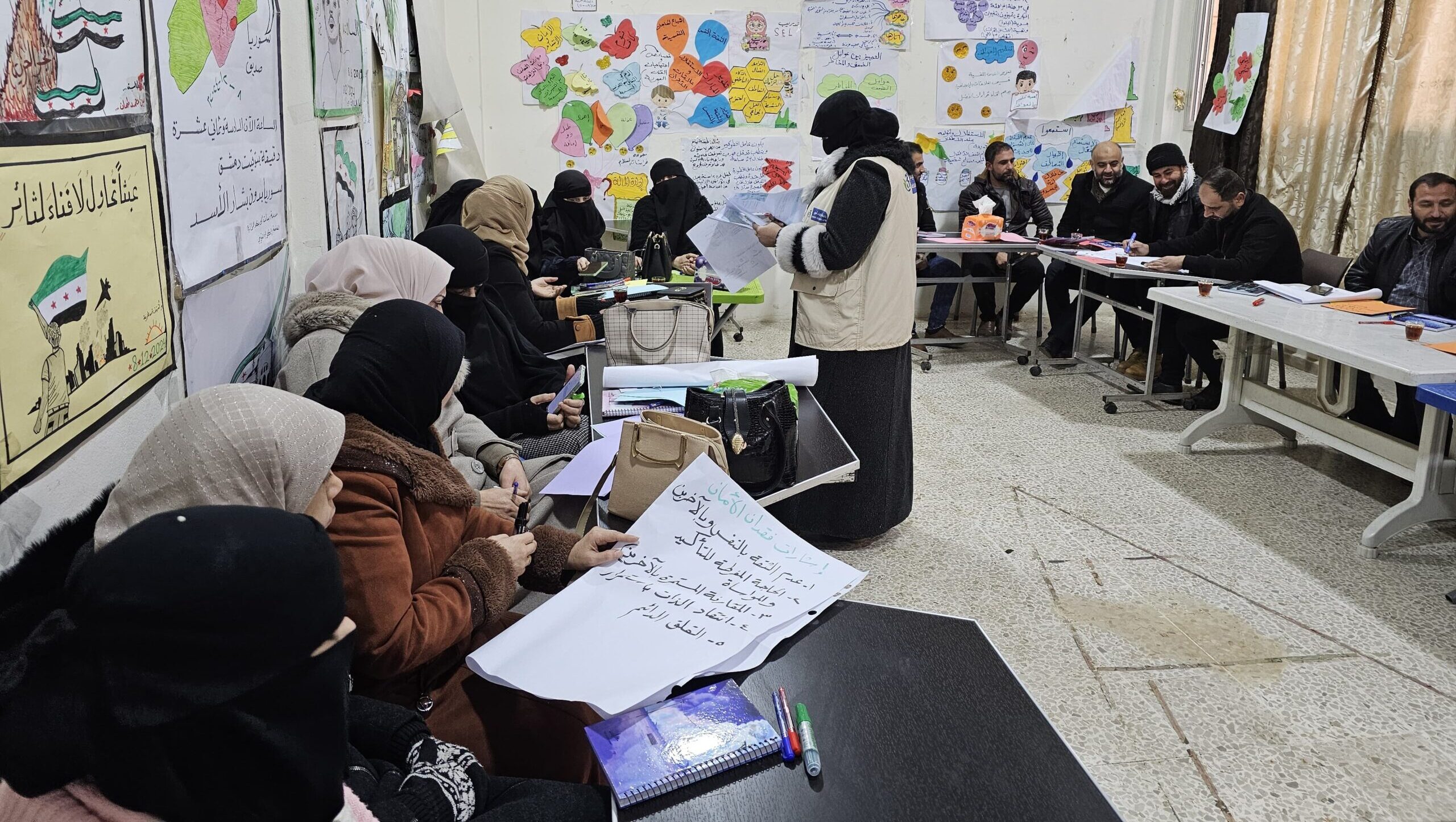
By 2025, the Association had built meaningful networks with NGOs and Education Directorates (EDs) and was ready to do something ambitious: as well as advocating for change, they decided to actively drive it. Working in partnership with the Idlib ED’s Special Education Division, they designed and delivered a series of workshops titled ‘Improving the School Environment for Persons with Disabilities’, which were rolled out across six regional educational assemblies for Head Teachers, Deputy Head Teachers and their delegates.
“With every parent who joins us, we grow in strength and understanding. We realise that one hand cannot clap alone, but hands together make a real difference. Our goal is for society to see our children as we see them.” – Haifaa, Association member
From inclusion awareness to deeper understanding
The workshops were deliberately sequenced to take school leaders on a journey – from examining the root causes of exclusion and stigma, through an understanding of the lived realities of students with disabilities, to the identification of practical, empathetic solutions.
Participants mapped the physical spaces within their schools where harm most commonly occurs. They worked through a shared definition of bullying — physical, verbal, psychological, social and digital. They explored how disability can harden into stigma when difference is treated as deficiency, and recognised the quieter forms of harm: exclusion from activities, over-protection, condescension, being spoken about rather than spoken to.
They examined their school communities’ responsibilities and the cost of delayed intervention. They identified positive indicators of social cohesion and belonging, and the warning signs of their absence: a child’s withdrawal, sudden academic decline, repeated unexplained absences.
‘My Steps in My School’: When Understanding Becomes Empathy and Action
One of the most powerful elements of the workshop series was an activity called ‘My Steps in My School.’
Participants were each assigned the identity of a student with different personal, physical and social attributes. A facilitator presented 17 scenarios. In response to each, participants stepped forward, stepped back, or held their ground — depending on whether their assigned identity was included or excluded by that scenario.
The result was not simply another discussion about inequity. It was the experience of it. School leaders physically felt what it means to be repeatedly left behind while peers advance. In Maarat Misrin, a Head Teacher described what she called an “internal oppression” and an urge to weep as she stepped backward again, and again, while peers moved ever onward.
This is the difference between training that informs and training that transforms. Empathy cannot be taught through statistics. It has to be felt. And when school leaders feel it, a desire for change shifts from a professional consideration to a personal responsibility.
Recommendations for inclusion action
Findings from these six regional workshops were carried forward into a seventh strategic workshop convened with the Education Directorate and partner organisations to ensure insights from the field directly shaped school- and institutional-level conversations.
Participants committed to embedding recommendations within school improvement plans and to strengthening partnerships between school, family and community. Practical calls to action included the appointment of psychological counsellors, training in inclusive education, clear anti-bullying policies, accessible infrastructure, and active engagement of parents.
The ripple effects have already begun. Following the workshops, Bonyan Organisation partnered with the Association to provide medical, health and nutritional services to 178 priority cases. The Association identified and supported children to receive mobility aids, glasses, hearing aid batteries, food parcels and stationery.
Mr Abdul Jawad Assaf, Head of the Inclusion and Disability Division within the Idlib’s ED, reflected on the significance of the workshops:
“We have attended several workshops and witnessed the diligent work being carried out by this Association, which demonstrates the extent of their dedication to the tasks entrusted to them.
We hope this work will expand to include other communities that have been recently liberated, so that everyone may have the opportunity to fulfil their assigned roles. For our part at the Directorate of Education, as Mr Muhammad mentioned, we offer them appropriate support.
We assure them that we stand with them, we value what they are doing, and we wish them success and prosperity.”
A lesson in parental participation
The Association of Caregivers demonstrates something that education systems everywhere can learn from. Family members are not passive recipients of school communication. They offer irreplaceable experience and knowledge. They carry personal urgency. And their voices can reach the hearts and minds of educators to make inclusion part of every child’s school experience.
When parents and caregivers are recognised as active stakeholders – by schools and by decision-makers – the results can be transformative.