People with disabilities comprise nearly a third of the population in Syria, according to Humanity & Inclusion.[1] That is nearly twice the global average – a staggering statistic due, in large part, to the violence of protracted conflict alongside the collapse of essential healthcare services.
For children with disabilities, persistent and multilayered challenges impact on their access to school and ability to participate equally in gaining education. In fact, UNICEF have reported that in northern Syria 72% of children with disabilities were not enrolled in school in 2023 – a proportion far higher than the 40% of their non-disabled peers.[2] Zooming out to consider the whole country, only 50% of children with disabilities have access to education.
Inclusive education initiatives
For the Syria Education Programme (SEP) II – known locally as Manahel – inclusion is a cornerstone of our work to strengthen the formal education system for primary school-aged children:
– school rehabilitation work foregrounds accessibility
– Teacher Competency Framework improves and measures inclusive teaching
– teacher training gives new skills in specialised instruction
– safeguarding training pays close attention to the vulnerabilities of learners with disabilities
– psychosocial support addresses specific vulnerabilities.
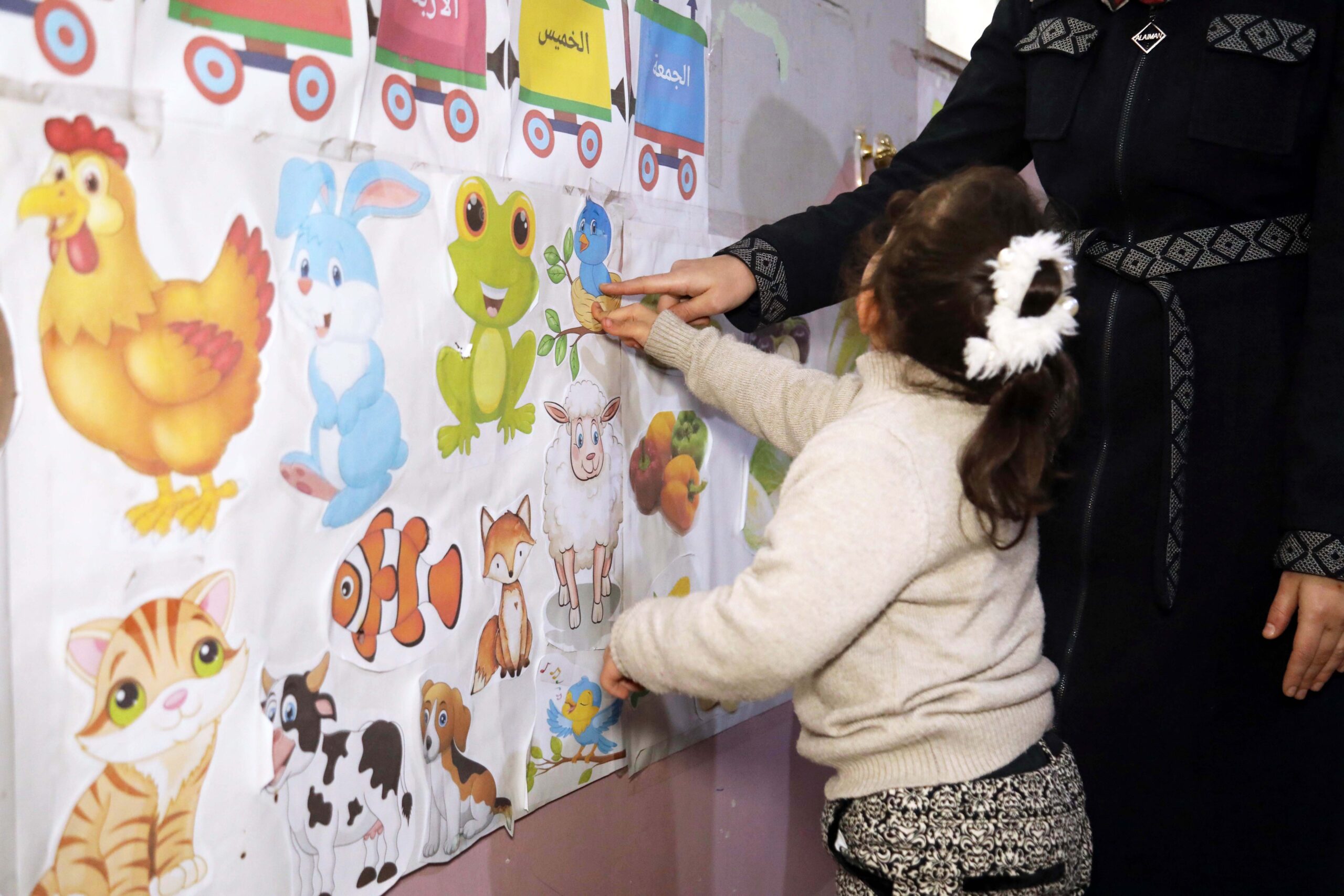
In addition, since 2021 Manahel has worked closely with partners to set up and support 50 Special Education Centres (SECs). These are resource rooms within primary schools that provide targeted support to children with disabilities and enables integration into mainstream education where possible. Each SEC accommodates up to 10 students per academic year – all of whom are supported through personalised learning plans that are tailored to meets specific needs.
Read more about the Manahel Special Education Centres here.
The role of community advocacy
Having seen the impact of an SEC on her sister, Salma was inspired to help set up an advocacy group of parents and caregivers.
“Even though there is a high need for such special-needs services in our communities, most schools do not provide them, and it is even worse when parents are not involved as they provide information on the child’s strengths and challenges at home, background information on the child’s history and development and information on any family factors that may affect the child’s learning.”
This group has now developed into the Association of Caregivers for Children Living with Disabilities. Its members are proactively involved in educational decision-making in their schools and Education Directorate (ED). They fiercely advocate for families and children who face barriers to traditional learning. They ensure that policies on widening inclusive practices are in place.
Since early 2023, the Association has spearheaded several impactful initiatives including addressing societal stigma and discrimination, providing educational support and raising community awareness on the capabilities and needs of children with disabilities.
In recent months, members have taken part in the development of the ED’s strategic plan to ensure policy is created and ensuring that these policies are implemented in all schools. Parents and caregivers are also contributing to the development of a common school delivery standard so that every child with a disability has access to high-quality education opportunities in an inclusive and secure setting, regardless of whether they reside in an urban or rural community.
Ongoing challenges
Despite progress in addressing the needs of children with disabilities in Syria, several persistent challenges remain:
· Physical barriers. Many schools across Syria lack the necessary infrastructure to accommodate children with disabilities. Facilities such as ramps, accessible restrooms and specialised classrooms are either absent or insufficient making it difficult for children with mobility or sensory impairments to attend school safely and comfortably.
· Teacher shortages and limited capacity. A critical lack of trained special education teachers, limited resources and lacking professional development opportunities limits inclusion.
· Deep-rooted cultural attitudes toward disability. Family and community understanding of disability often leads to exclusion and marginalisation.
· Lack of funding. Humanitarian aid efforts prioritise shelter, general education, and WASH (water, sanitation, and hygiene) needs that are not often tailored to the needs of children with disabilities.
A more inclusive future is possible
We’ve already seen positive change in northwest Syria, which could be scaled up and rolled out to other schools across the country.
During this time of rebuilding – infrastructure, policy and systems – there is enormous opportunity to achieve lasting inclusion through urgent policy action that prioritises the following areas:
· School rehabilitation that factors in accessibility and adapted classrooms.
· Investment in inclusive teacher training.
· Awareness campaigns to challenge negative attitudes and promote inclusion.
· Prioritise funding and aid programmes that meaningfully address disability inclusion.
· Strengthen community, parent and caregiver involvement in educational planning.
By embracing a rights-based approach and fostering a supportive, inclusive educational environment, Syria can build a future where all its children have the opportunity to reach their full potential.